Advertisement

Mikayla Easley

Mikayla Easley reports on the Pentagon’s acquisition and use of emerging technologies. Prior to joining DefenseScoop, she covered national security and the defense industry for National Defense Magazine. She received a BA in Russian language and literature from the University of Michigan and a MA in journalism from the University of Missouri. You can follow her on Twitter @MikaylaEasley

Articles by Author
A U.S. Marine Corps Hero-400 loitering munition drone is staged before flight on San Clemente Island, California, May 25, 2022. The Hero-400 is a loitering munition that the United States Marine Corps and other Department of Defense entities are beginning to incorporate into specific mission sets. This initial training flight develops the unmanned aerial systems pilots’ confidence and abilities to be able to operate the Hero-400 in any clime and place, and enabling 3rd MAW to remain a more lethal and ready force. (U.S. Marine Corps photo by Lance Cpl. Daniel Childs)

Marines to develop air-launched loitering munitions with swarm capability for Indo-Pacific operations

Weapons
U.S. Marine Corps Col. Timothy Brady, the commanding officer of 3d Marines, conducts command and control (C2) of an air assault utilizing the Network On-the-Move Airborne (NOTM-A) communications system during Large Scale Exercise 2021, Marine Corps Base Hawaii, Aug. 12, 2021. The NOTM-A provides a C2 capability to mission commanders while airborne, enhancing battlefield management and awareness. LSE 2021 is a live, virtual, and constructive exercise employing integrated command and control, intelligence, surveillance, reconnaissance, and sensors across the joint force to expand battlefield awareness, share targeting data, and conduct long-range precision strikes in support of naval operations in a contested and distributed maritime environment. (U.S. Marine Corps photo by Sgt. Josue Marquez)

Marine force design plans include overhauling C2, data capabilities to support ‘all-domain’ ops

Emerging Tech
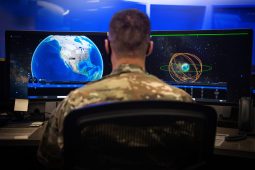
Crews of the National Space Defense Center at provide threat-focused space domain awareness across the nation security space enterprise. The NSDC was originally established in 2015 as the Joint Interagency Combined Space Operations Center and was renamed in 2017 to more accurately reflect its mission. (U.S. Space Force photo by Kathryn Damon)

A look at Space Operations Command’s ‘needs list’ for AI, machine learning

AI
Advertisement
Advertisement